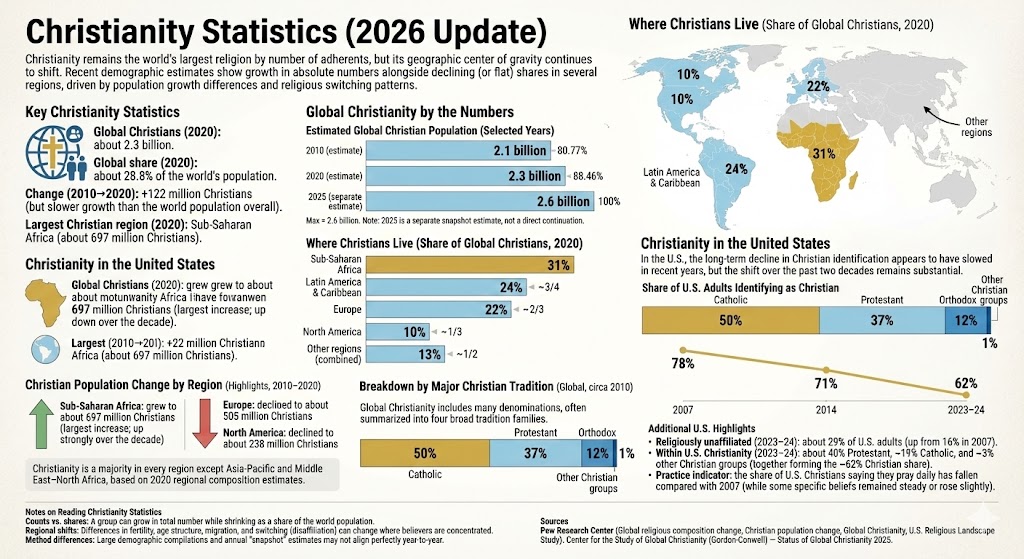
Christianity remains the world’s largest religion by number of adherents, but its geographic center of gravity continues to shift. Recent demographic estimates show growth in absolute numbers alongside declining (or flat) shares in several regions, driven by population growth differences and religious switching patterns.
Global share (2020): about 28.8% of the world’s population.
Change (2010→2020):+122 million Christians (but slower growth than the world population overall).
Largest Christian region (2020):Sub-Saharan Africa (about 697 million Christians).
U.S. Christian identification:78% (2007) → 71% (2014) → 62% (2023–24).
Global Christianity by the Numbers
Estimated Global Christian Population (Selected Years)
This chart combines widely cited benchmark estimates: 2010 and 2020 global counts from large-scale demographic compilation work, plus a separate 2025 “snapshot” estimate from a global Christianity research center. Because methods differ, treat the 2025 point as a separate estimate rather than a perfect continuation of the same series.
Where Christians Live (Share of Global Christians, 2020)
In 2020, Sub-Saharan Africa became the region with the largest share of the world’s Christians. Latin America and Europe remain major centers, while the Asia-Pacific and Middle East–North Africa regions together account for the remaining share not covered by the four largest buckets below.
Label
Bar
Value
Sub-Saharan Africa
31%
Latin America & Caribbean
24%
Europe
22%
North America
10%
Other regions (combined)
13%
Max = 31%. Widths: Sub-Saharan Africa 100.00%, Latin America & Caribbean 77.42%, Europe 70.97%, North America 32.26%, Other regions 41.94%.
Christian Population Change by Region (Highlights, 2010–2020)
Sub-Saharan Africa: grew to about 697 million Christians (largest increase; up strongly over the decade).
Europe: declined to about 505 million Christians.
North America: declined to about 238 million Christians.
Christianity is a majority in every region except Asia-Pacific and Middle East–North Africa, based on 2020 regional composition estimates.
Breakdown by Major Christian Tradition (Global, circa 2010)
Global Christianity includes many denominations, but it is often summarized into four broad tradition families. In a widely cited global estimate (circa 2010), about half of Christians were Catholic, a little over one-third were Protestant, around one-eighth were Orthodox, and a small remainder fell into “other” Christian groups.
Label
Bar
Value
Catholic
50%
Protestant
37%
Orthodox
12%
Other Christian groups
1%
Max = 50%. Widths: Catholic 100.00%, Protestant 74.00%, Orthodox 24.00%, Other 2.00%.
Christianity in the United States
In the U.S., the long-term decline in Christian identification appears to have slowed in recent years, but the shift over the past two decades remains substantial.
Share of U.S. Adults Identifying as Christian
Label
Bar
Value
2007
78%
2014
71%
2023–24
62%
Max = 78%. Widths: 2007 100.00%, 2014 91.03%, 2023–24 79.49%.
Additional U.S. Highlights
Religiously unaffiliated (2023–24): about 29% of U.S. adults (up from 16% in 2007).
Within U.S. Christianity (2023–24): about 40% Protestant, ~19% Catholic, and ~3% other Christian groups (together forming the ~62% Christian share).
Practice indicator: the share of U.S. Christians saying they pray daily has fallen compared with 2007 (while some specific beliefs remained steady or rose slightly).
Notes on Reading Christianity Statistics
Counts vs. shares: A group can grow in total number while shrinking as a share of the world population.
Regional shifts: Differences in fertility, age structure, migration, and switching (disaffiliation) can change where believers are concentrated.
Method differences: Large demographic compilations (censuses/surveys) and annual “snapshot” estimates may not align perfectly year-to-year.
Sources
Pew Research Center — Global religious composition change from 2010 to 2020 (including Christianity).
Pew Research Center — Christian population change (2010–2020), with regional distribution highlights.
Pew Research Center — Global Christianity (size and distribution; tradition breakdown).
Pew Research Center — U.S. Religious Landscape Study (2007, 2014, 2023–24) and related analysis.
Center for the Study of Global Christianity (Gordon-Conwell) — Status of Global Christianity 2025.