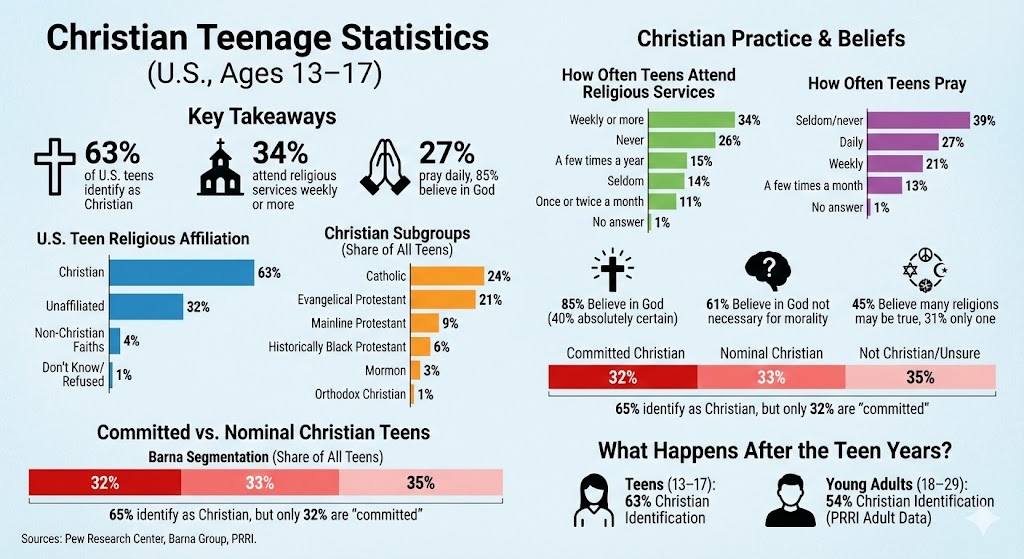
This roundup pulls together recent, high-quality survey findings about Christian identification, belief, and practice among teenagers (typically ages 13–17). Where possible, figures are shown as shares of all teens (not just teens who identify as Christian).
63% of U.S. teens ages 13–17 identify as Christian (survey conducted in 2019; reported by Pew Research Center in 2020).
Among all U.S. teens, 24% are Catholic and 21% are evangelical Protestant.
32% of U.S. teens are religiously unaffiliated (“nones”).
34% of U.S. teens attend religious services weekly or more often; 26% never attend.
27% of U.S. teens pray daily, while 39% say they seldom or never pray.
85% of U.S. teens say they believe in God (with 40% saying they’re absolutely certain).
Barna reports that 65% of U.S. teens identify as Christian, but only 32% are “committed Christians” (self-identify as Christian and say they’ve made a personal commitment to follow Jesus).
In PRRI’s adult data, a slim majority of Americans ages 18–29 (54%) identify as Christian—highlighting the drop that often happens after the teen years.
How many teenagers identify as Christian?
In Pew’s nationally representative survey of U.S. teens ages 13–17, 63% identified as Christian and 32% as religiously unaffiliated. A smaller share (4%) identified with non-Christian faiths, and 1% did not give an answer.
U.S. teen religious affiliation
Label
Bar
Value
Christian
63%
Unaffiliated
32%
Non-Christian faiths
4%
Don’t know/refused
1%
Max = 63%. Widths: Christian 100.00%, Unaffiliated 50.79%, Non-Christian faiths 6.35%, Don’t know/refused 1.59%.
Pew also finds that teens are modestly less likely than their parents to identify as Christian (63% vs. 72%), and 17% of teens report a different religious affiliation than the parent who took the survey.
Christian subgroups among U.S. teens
Looking only at Christian categories (still as a share of all U.S. teens), Catholic and evangelical Protestant identification are the two largest groups.
Label
Bar
Value
Catholic
24%
Evangelical Protestant
21%
Mainline Protestant
9%
Historically Black Protestant
6%
Mormon
3%
Orthodox Christian
1%
Max = 24%. Widths: Catholic 100.00%, Evangelical Protestant 87.50%, Mainline Protestant 37.50%, Historically Black Protestant 25.00%, Mormon 12.50%, Orthodox Christian 4.17%.
Christian practice among teenagers
Religious practice varies widely. On “traditional” measures (attendance, prayer), many teens report low frequency—especially among the religiously unaffiliated. Pew also reports that teens’ religious practice often happens with family (for example, shared attendance and rituals).
How often teens attend religious services
Label
Bar
Value
Weekly or more
34%
Never
26%
A few times a year
15%
Seldom
14%
Once or twice a month
11%
No answer
1%
Max = 34%. Widths: Weekly or more 100.00%, Never 76.47%, A few times a year 44.12%, Seldom 41.18%, Once or twice a month 32.35%, No answer 2.94%.
Denomination and affiliation matter a lot for practice. For example, Pew reports that 64% of evangelical Protestant teens attend church weekly or more often, and 51% pray at least daily—substantially higher than other groups.
How often teens pray
Label
Bar
Value
Seldom/never
39%
Daily
27%
Weekly
21%
A few times a month
13%
No answer
1%
Max = 39%. Widths: Seldom/never 100.00%, Daily 69.23%, Weekly 53.85%, A few times a month 33.33%, No answer 2.56%.
In Pew’s survey, about 60% of U.S. teens say they have participated in religious education at some point, and 51% say they have ever attended a youth group.
Beliefs and importance
24% of U.S. teens say religion is “very important” in their lives; 36% say “somewhat important.”
85% say they believe in God (including 40% who are absolutely certain and 34% fairly certain).
61% say belief in God is not necessary to be moral and have good values.
On religious exclusivity vs. pluralism, 45% say many religions may be true, while 31% say only one religion is true.
Committed vs. nominal Christian teens
Some research separates “Christian identification” from “Christian commitment.” In Barna’s Open Generation research, 65% of U.S. teens identify as Christian, but only 32% are categorized as “committed Christians” (with another 33% categorized as “nominal Christians”).
Barna segmentation of U.S. teens
Label
Bar
Value
Committed Christian
32%
Nominal Christian
33%
Not Christian/unsure
35%
Max = 35%. Widths: Committed Christian 91.43%, Nominal Christian 94.29%, Not Christian/unsure 100.00%.
Barna also reports that teens’ curiosity about Jesus is widespread: 77% say they are at least somewhat motivated to continue learning about Jesus (including 52% “very motivated”).
What happens after the teen years?
Multiple datasets show that Christian identity is typically lower among young adults than among teens. PRRI’s 2024 county-level “Census of American Religion” reports that 54% of Americans ages 18–29 identify as Christian (adult data). Pew’s recent analysis likewise finds young adults are much less religious than older Americans and sees no clear evidence of a broad “religious revival” among young U.S. adults.
Sources
Pew Research Center. “U.S. Teens Take After Their Parents Religiously, Attend Services Together and Enjoy Family Rituals” (report based on a survey conducted March 29–April 14, 2019). PDF: https://www.pewforum.org/wp-content/uploads/sites/7/2020/09/PF_20.09.10_teens.religion.full_.report.pdf
Barna Group. “Over Half of Gen Z Teens Feel Motivated to Learn More About Jesus” (Feb 1, 2023): https://www.barna.com/research/teens-and-jesus/
Barna Group. “52% of Teens Are ‘Very Motivated’ to Learn About Jesus” (Jan 30, 2025): https://www.barna.com/trends/teens-curious-about-jesus/
PRRI. “2024 PRRI Census of American Religion” (May 5, 2025): https://prri.org/spotlight/2024-prri-census-of-american-religion/
Pew Research Center. “Religion Holds Steady in America” (Dec 8, 2025): https://www.pewresearch.org/religion/2025/12/08/religion-holds-steady-in-america/